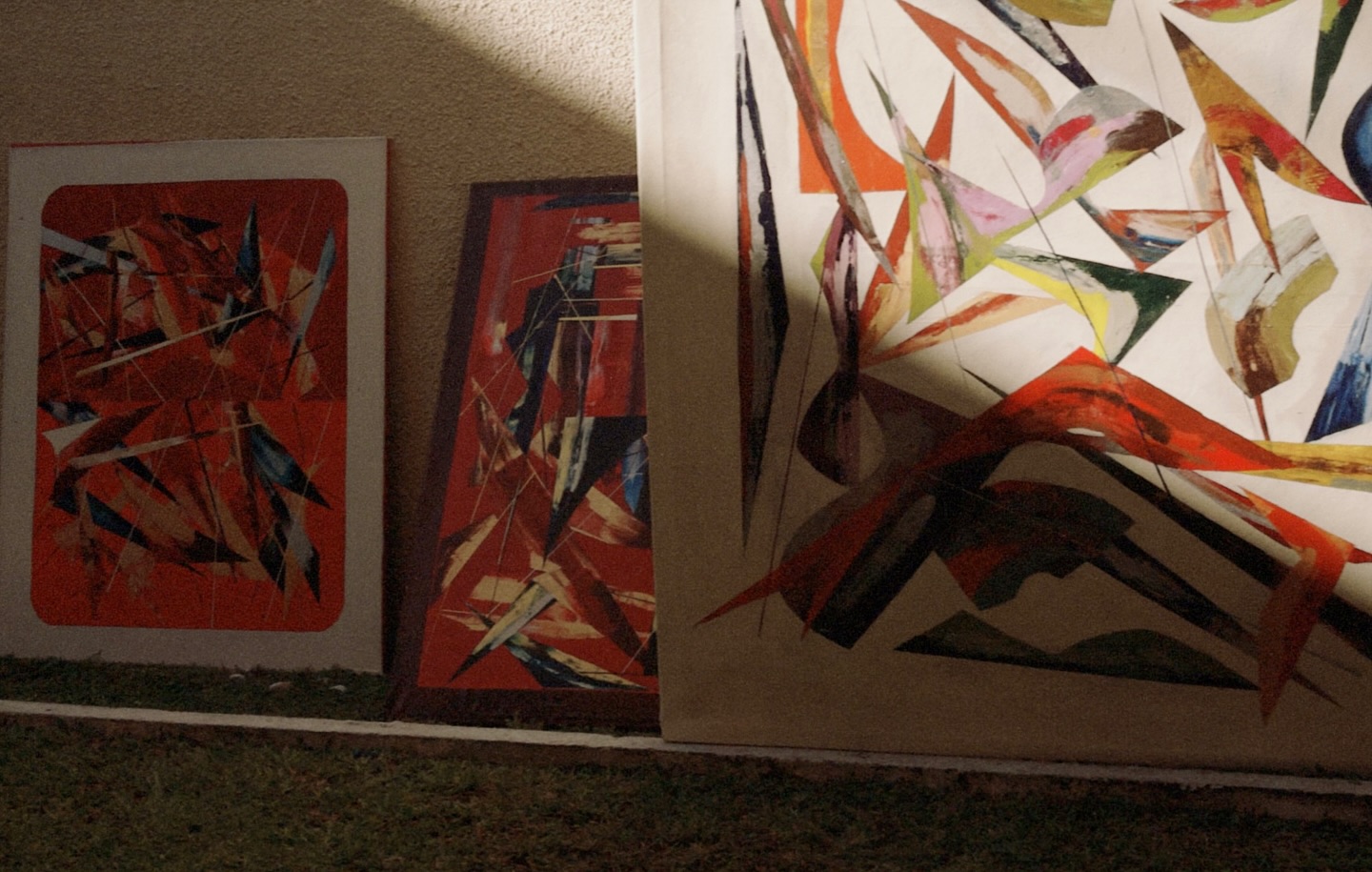
A refraction isn't complicated. Light travels through air, hits water or glass, changes direction. It's physics at its most basic—something you see every day and rarely notice.
That ordinariness is exactly why I became obsessed with it.
The Moment Refraction Became Everything
I discovered refraction the way you discover something hiding in plain sight. In Paris, during my first winter, when light became scarce and therefore invaluable.
I'd wake in darkness. Work in studio as dusk fell. The few hours of daylight felt precious, almost sacred. I started paying obsessive attention to how light moved—not as pleasant background, but as the subject itself. How it bent through windows. Where it pooled on surfaces. The exact instant when light met matter and transformed into something else entirely.
That's when I realized: I'd been searching for this my entire artistic career. A phenomenon that was simultaneously physics, metaphor, visual language, and philosophical inquiry all at once.
Refraction became my framework for understanding everything I wanted to say about being present in the world.
The Three Phases: A Complete System
Refraction isn't a single moment—it's a sequence. I broke it into three distinct phases, each with its own visual language, emotional resonance, and conceptual weight.
Phase One: The Incident
The incident is light traveling through space. It's potential. Movement. Everything that exists before contact. Visually, I represent the incident through directional elements, colors that suggest momentum, geometric forms pointing toward an imminent threshold.
In human terms, the incident is the approach. Experiences coming toward us. Moments we're about to encounter. The energy that hasn't yet been transformed by contact with reality.
In my paintings, the incident phases use colors suggesting movement—yellows that appear to travel, blues that suggest velocity. The forms point and direct. They create anticipation.
Phase Two: The Point of Incidence
This is where everything concentrates. The precise instant light meets the boundary between two mediums. It's the threshold, the contact point where transformation becomes inevitable.
Nothing happens at the point of incidence. Everything is about to happen. There's immense potential energy concentrated in this moment—the instant before change, where the future branches out from a single point of contact.
I represent points of incidence using saturated metallics, deep reds, intense oranges. Colors that suggest energy, tension, contained power. The geometry becomes more defined here—sharp angles, precise boundaries, the sense of forces meeting at a specific location.
This phase asks: What happens at the moment of meeting? Where does potential become kinetic? What threshold are we standing at?
Phase Three: The Refraction
Light bends. Scatters. Reveals structures that were always there but invisible until this moment. This is transformation itself—the moment when something ordinary becomes revelatory.
The refraction phase is where my chromatic flattening technique fully emerges. Colors coalesce organically. Multiple wavelengths of light separate and reveal complexity that was compressed into white light. This is expansion, revelation, the moment when hidden structure becomes visible.
Each piece in the refraction phase asks: What becomes visible when we're transformed by encounter? What new structures emerge? What was always there but invisible?
Technical Execution: Chromatic Flattening
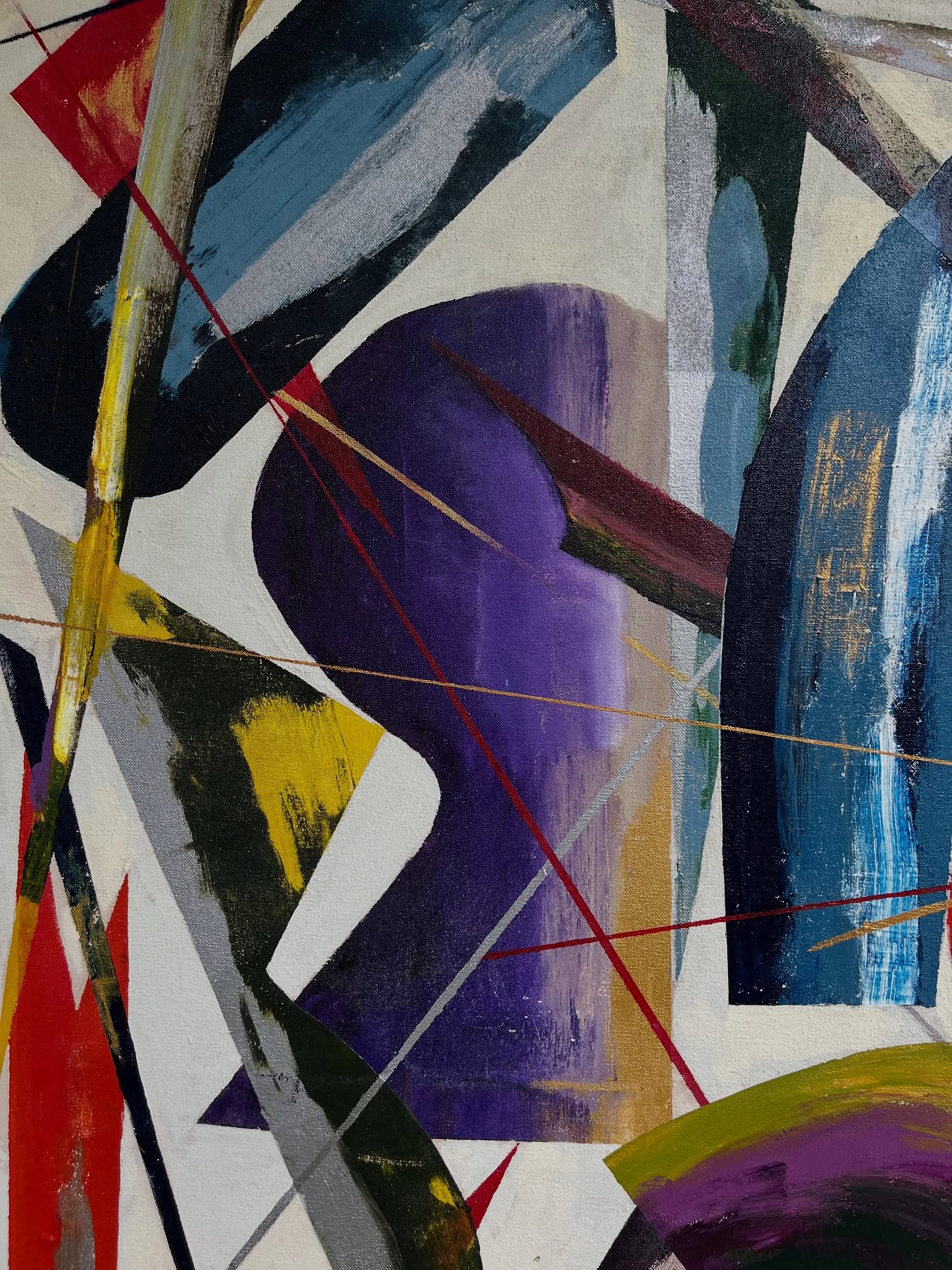
To translate these three phases into visual form, I developed a technique I call chromatic flattening. It allows saturated colors to merge organically while maintaining geometric precision.
The process begins with structure. I map out geometric divisions on self-primed canvas—not arbitrary, but intentional. These divisions hold the three phases, creating visual scaffolding for the concepts.
Then I pour. I work with metals, pastes, and acrylics. I pour fluid colors into the geometric areas, allowing them to interact at their own pace. Colors meet each other, blend at different rates, create gradations I can guide but never fully control. This organic coalescence is essential—it's the visual equivalent of how refraction works.
As layers accumulate, I apply the flattening technique. I compress colors into unified planes while preserving their internal interaction. This creates visual depth without traditional perspective. The surface remains flat, but complexity suggests dimensionality.
At key points of incidence—the contact zones between phases—I introduce metallic elements that catch light physically. The work doesn't just depict refraction. It enacts refraction on its own surface.
Why This Collection Matters
In a world designed to accelerate us—constant consumption, relentless distraction, the pressure to move on to the next thing—refraction offers something different. It asks us to slow down. To notice transitions usually invisible. To find extraordinary complexity in ordinary phenomena.
Most people walk past refractions constantly without seeing them. A glass of water, morning light through rain, shadows on pavement—these contain infinite visual and conceptual complexity. We just habitually ignore them.
My refraction collection invites viewers to notice what they've been missing. To discover that paying attention reveals depth. That slow observation transforms the ordinary into the revelatory.
The Philosophy Moving Forward
The refraction collection continues to evolve. I'm exploring how refraction manifests in different contexts—urban spaces, diurnal cycles, social interactions. Each exploration maintains the same core question: What becomes visible when we slow down enough to notice?
Refraction isn't just my subject matter. It's become my methodology, my metaphor for how I understand what art can do when it prioritizes presence over distraction, being over consuming, invitation over imposition.